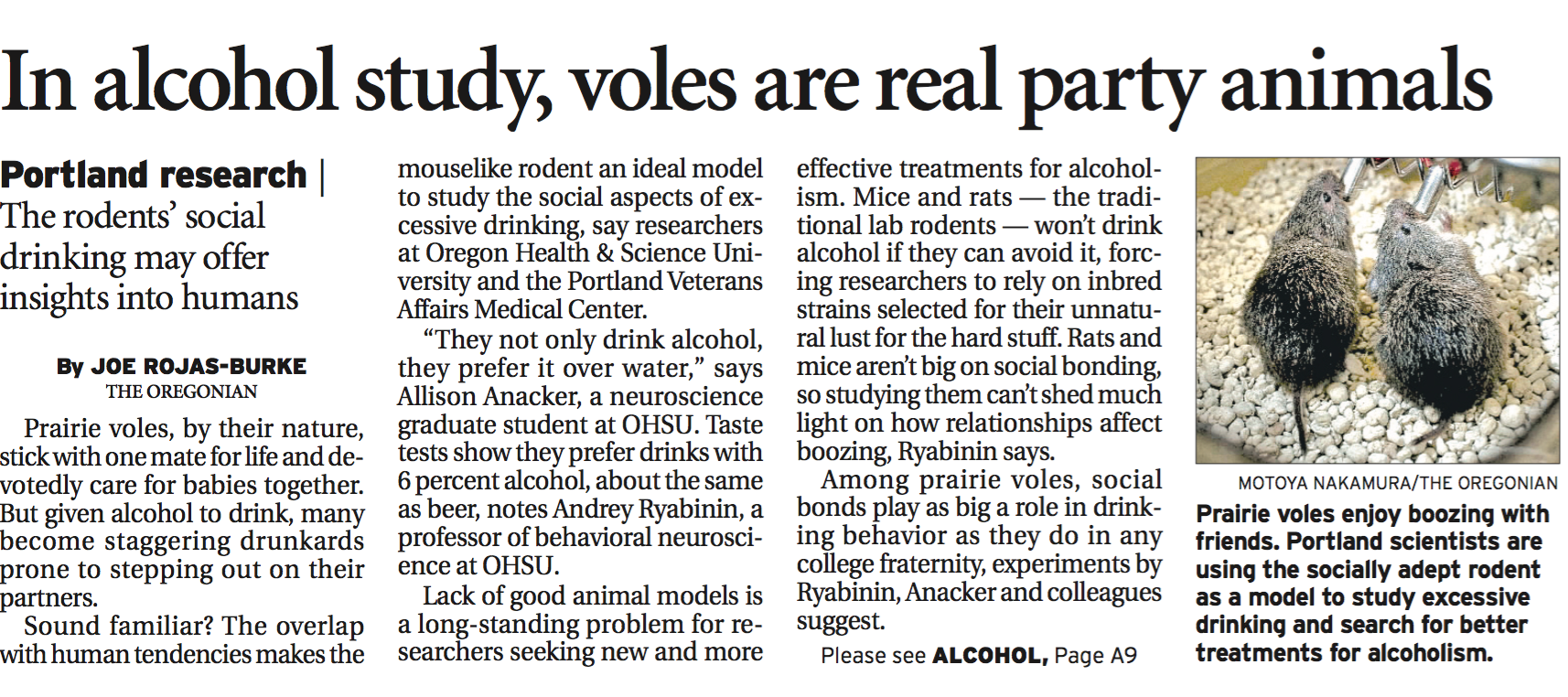
Prairie voles, by their nature, stick with one mate for life and devotedly care for babies together. But given alcohol to drink, many become staggering drunkards prone to stepping out on their partners.
Sound familiar?
That’s the opening to a story about researchers who are using the prairie vole, a mouse-like rodent, as a model to study the social aspects of excessive drinking. To succeed, a research story needs to have an enticing lede that hints at even better things to come. If you overheard it at a cocktail party, you would want step on over to enjoy the tale about to be told.
Of course, the point isn’t just to entertain. There are complicated scientific concepts that must be conveyed, and there is a risk that the details could get too taxing for those following the story. That’s why it’s necessary to make clear right away why the story matters:
Lack of good animal models is a long-standing problem for researchers seeking new and more effective treatments for alcoholism. Mice and rats – the traditional lab rodents – won’t drink alcohol if they can avoid it, forcing researchers to rely on inbred strains selected for their unnatural lust for the hard stuff. Rats and mice aren’t big on social bonding, so studying them can’t shed much light on how relationships affect boozing…
A good research story has to have narrative drive. Experiments unfold with surprising results leading to enlightening discoveries. The tone has to strike a delicate balance. It must continue to be engaging without becoming unserious. It must be easy to follow, but maintain scrupulous accuracy. The story should be vivid with unforgettable details:
In one study, soon to be published in the journal Addiction Biology, sharing a cage with a sibling prompted voles to imbibe more liquor. Each animal had access to two drinking bottles: one with plain water and another spiked with alcohol. A screen kept the paired animals from reaching each other’s bottles, making it easy for researchers to measure how much they drank.
The isolated voles drank nearly equal amounts of plain water and alcohol- spiked water. The siblings housed together partied down. On average, four- fifths of their fluid intake came from the alcohol-spiked source. But that isn’t all. The pairs living together also matched each other drink for drink.
Some voles drank so much they staggered and fell and had trouble getting back on their feet. Others drank more moderately. But each vole always drank nearly the same amount as its cage-mate.
The most common failure of research stories is hype. Press releases and news stories routinely overstate the importance and originality of research findings. A good research story should accurately portray the way science advances in small increments, heavily dependent on the discoveries of others, and subject to future revision. It’s important to point out the limits:
Though human behavior is too complicated for any one animal model to fully represent it, voles should prove useful for examining social dimensions of drinking, says Kenneth Sher, a University of Missouri professor who studies the psychology of alcohol addiction.
Endings are tricky but a story isn’t complete without a good kicker. It should work like a punch line, satisfying a need and rewarding those who stuck with the narrative until its end. It’s the last thing readers will take from the experience, so it deserves as much attention as the lede:
Preliminary findings at OHSU also suggest that high alcohol consumption can interfere with the voles’ naturally close bonds. Even in the rodent world, boozing too much is an invitation for domestic strife.
∞
I wrote this a while back as part of a job interview; the employer asked me to explain what makes a good science news story. The example I used was something originally published in The Oregonian newspaper: A real party animal helps scientists study alcohol abuse.
 joe rojas-burke